Arc Flash Risk for Mid Valley Facility Maintenance Teams
Arc flash risk in a Mid Valley commercial building shows up the day an in-house maintenance tech opens a switchboard that has not been opened in a decade. The panel cover comes off. A tool slips. A phase to ground arc lights up, and a person who has been doing this job for fifteen years is in the emergency room before the supervisor finishes the next email.
The hard part is that the building has been quiet up to that point. The breakers have been holding. The equipment has been running. The maintenance routine has been the same Tuesday morning walk-through for years. The risk does not announce itself. It accumulates.
This post covers what arc flash actually is in concept, what raises the risk in aging commercial gear, what an arc flash study looks at in concept, what lockout/tagout practice is supposed to do in concept, and the line where an in-house facility team should stop and call our service department in.
What Is an Arc Flash Inside a Mid Valley Commercial Switchboard by Concept and Why Should a Facility Manager Care?
An arc flash is a short circuit through the air. A conductor breaks down its insulating distance to another conductor or to ground. The air ionizes, and the energy in the system pours into the gap. The temperature inside that arc can climb past anything a human body can survive. The blast pushes hot copper vapor and debris outward at high speed.
A facility manager should care because the people most likely to be standing in front of that gear are the in-house techs. The outside contractor visits once a year. The maintenance team is in there every week.
Arc flash energy is not the same across every panel in the building. The available fault current at a small lighting panel is much lower than at the main switchboard. The size and condition of the gear matter. The upstream protective device, its clearing time, and the working distance also affect the picture. An arc flash study by concept is the way a facility owner finds out which gear is which.
How Does the Working Condition of an Aged Commercial Panel Change the Arc Flash Risk Picture for an In-House Maintenance Tech?
Aged gear raises the risk in ways the facility team often does not see. Loose bus connections build heat. Insulating barriers break down. Contaminants and moisture find their way in. The breaker that has not tripped in twenty years may not trip in a tenth of a second the next time, either. That matters because the energy in an arc keeps dumping into the gap until something interrupts it.
A panel that looked fine at the last walk-through can fail on the next breaker swap.
The working space requirements by concept exist for a reason. The rules know what happens when a person has to reach across an energized bus to get to a fault. The clearance requirements by concept exist because the rules account for how far debris can fly. When the working space is full of stored equipment, the clearance in front of the gear is gone. The tech who has to stand in there has fewer options when something goes wrong.
What Does an Arc Flash Study Look at by Concept for a Salem Area Commercial or Industrial Facility?
An arc flash study by concept starts with the utility transformer feeding the building. The available fault current at the service entrance is calculated by concept. The study walks the one-line diagram by concept down through the main, the feeders, the panelboards, the motor control centers, and out to the equipment.
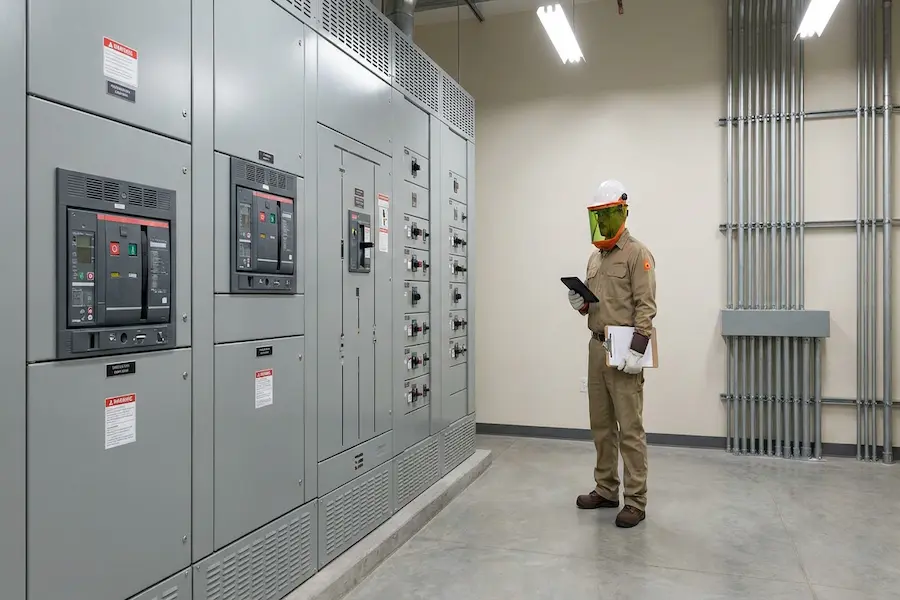
At each piece of gear, the study estimates the incident energy and the boundary by concept. That information drives the label applied to the gear by concept. That label is what the maintenance tech reads before deciding what PPE to put on and how close to get.
The study also flags upstream coordination issues. A main breaker that does not clear quickly when a downstream fault occurs is a study finding by concept. A feeder size that does not match the equipment ground fault profile is a study finding by concept. These are the kinds of things our project team and the facility manager talk through together when the study comes back.
The study is not a one-time document for a Mid Valley facility that has been growing. New loads change the picture. New equipment changes the picture. A transformer swap by the utility changes the picture.
How Does Lockout Tagout Practice Reduce Arc Flash Exposure on a Commercial Maintenance Visit by Concept?
Lockout/tagout practice, by concept, is the discipline of de-energizing equipment before working on it. The disconnect gets opened. The lock goes on. The tag goes on. The absence of voltage gets verified before anyone touches the conductors.
When a piece of gear is locked out and verified dead, the arc flash exposure to that gear is gone for the duration of the work.
The practical problem is that not every task is a lockout tagout task. Reading a meter, taking a thermal image of a panel cover, checking a control circuit, and troubleshooting a live problem all happen on energized gear. Those are the tasks where the arc flash label and the PPE choice matter.
An in-house team that treats every task as a live task is taking more risk than it needs to. An in-house team without a clear written boundary between energized and de-energized work is taking risks it cannot see.
We work with facility teams on the planning side of this. Which tasks get done energized? Which tasks get scheduled for a planned shutdown? Which tasks belong with the in-house team and which tasks belong with our service department? That conversation is the one that changes the risk profile.
When Should a Mid Valley Facility Team Stop and Call Our Commercial Service Department Instead of Working Inside the Gear?
A few situations should pull the in-house tech back and pull our service department in.
- Gear past its service life: When the equipment is decades old, shows heat damage at the bus, or carries a manufacturer or model on watch lists, the conversation shifts. Replacement is the talk, not the next breaker swap.
- An arc flash label that calls for PPE the team does not have: When the label calls for protection the facility crew does not stock, the right move is to schedule the work with a crew that does. Our service department carries the rated gear and the trained workforce for that scope.
- Repeated nuisance trips on a main or a feeder: When a main keeps tripping for reasons no one can explain, the answer is upstream. A diagnostic with the gear de-energized, the bus opened, and the connections checked is the right answer.
- Recent thermal imaging showing hot spots at the bus or at a connection point: That is not something to live with. That is a thing to scope and fix before it fails.
- A pending fire marshal or insurance carrier inspection of the building: When an outside inspector is coming, the right time to address findings is before the letter arrives.
Our commercial service team works with property managers and facility teams across Salem, Keizer, Woodburn, Albany, and the rest of the Mid Valley on scoping conversations like this. We are not trying to take the easy work off the in-house team. We are trying to make sure the hard work happens with the right plan.
Arc Flash and Lockout Tagout FAQ for Salem and Mid Valley Facility Teams
Does Our Facility Need an Arc Flash Study by Concept if We Have Not Had One Done?
Probably yes. A commercial or industrial building with switchgear, motor control centers, or large feeders that has not had a study may have gear with labels that do not reflect the current condition of the system. The starting point is a walk-through with our service team and a conversation about the one-line diagram by concept.
The study is also a planning tool. It tells the facility manager which gear has the highest exposure, which has the lowest, and where the budget should go first. Without it, the in-house team is guessing.
Can Our In House Maintenance Tech Replace a Breaker in a Commercial Panelboard Without Calling Us?
It depends. The gear size, the panel condition, the available fault current at that location by concept, and the facility’s work permit procedure by concept all drive the answer. A small lighting panel breaker swap is a different task than a main breaker swap in a switchboard.
Many facilities do not have a written policy specifying which tasks the in-house team handles and which the service department handles. That policy is the first thing to build. We help frame it.
What PPE Categories by Concept Matter for an In-House Tech Working Inside Commercial Electrical Gear?
The label on the gear sets the PPE category by concept. The category drives the clothing, the face shield, the gloves, and the boundary that the worker has to maintain. The label is the controlling document for that task.
A facility team without arc-rated PPE in the closet should not be opening energized gear. Period.
How Often Should an Arc Flash Study Get Updated for a Mid Valley Commercial Building?
The trigger is change. New equipment, a new transformer at the utility side, a feeder upgrade, a panel swap, and a breaker setting change. Any of those can change the picture. A common practice by concept is to revisit the study on a defined cycle and also after any meaningful electrical change in the building.
Can the Same Crew That Does Our Commercial Service Work Also Do Our Planned Maintenance?
Yes. Our commercial service department handles planned preventive maintenance contracts for property managers, facility teams, and owners in the Salem area. The same crew that knows the gear handles the inspection, the thermal imaging, the breaker exercise, and the rest of the scope.
Talk to Photo Electric Before the Next Maintenance Visit
Photo Electric works with Mid Valley facility teams on the arc flash and lockout tagout side of commercial maintenance every week. The conversation starts with a walk-through and a look at the one-line diagram by concept. From there, we talk through which work belongs with the in-house team and which belongs with our service department. Call us before the next breaker swap, not after the next incident.